

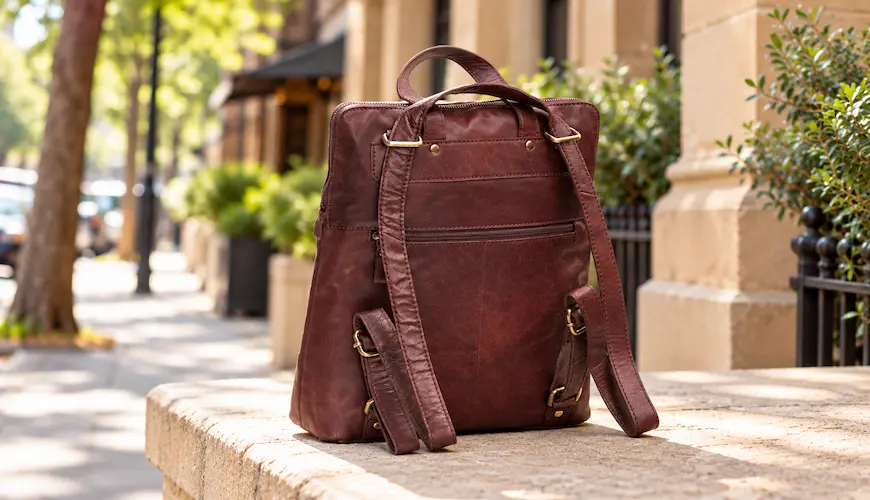
TLDR: Convertible leather backpacks are worth considering if you regularly switch between backpack and shoulder-bag carry, and both options work with what you normally pack. Check the straps, usable space, loaded weight and access before buying: a second carrying option is only useful if you actually enjoy using it.
In This Guide
- What is a convertible leather backpack?
- When is a convertible backpack worth it?
- Convertible backpack vs backpack vs shoulder bag
- How to check fit, space and access
- Will it fit and protect your laptop?
- What does the research say about carrying comfort?
- Leather, straps and construction: what matters?
- Rain, care and keeping belongings secure
- Is it good value for money?
- The buying checklist and final verdict
- Frequently asked questions
What Is a Convertible Leather Backpack?
A convertible leather backpack is a bag that changes between carrying styles, usually a two-strap backpack and a shoulder bag. You keep the same bag and contents, but change how the straps are arranged.
That sounds like a small detail until your day involves a walk to the station, a crowded train, work and a few errands afterwards. Backpack carry may suit one part of that trip; shoulder carry may be more convenient for another.
However, convertible describes the carrying options, not the storage, support or protection. It does not automatically mean the bag fits a laptop, has padded straps, works as a crossbody bag or suits a heavy load. Those features need checking separately when browsing women's leather backpacks.
How do convertible straps work?
There is no single conversion system. Common arrangements include:
- Pull-through straps: a sliding strap arrangement changes the bag between shoulder and backpack carry.
- Detachable straps: clips move between the attachment points intended by the maker.
- Separate straps: backpack straps and a shoulder strap are separate pieces, sometimes with a place to tuck unused straps away.
The Gabee Ellie 2-in-1 bag stocked by Leatherland, for example, uses pull-through straps. Its listing also describes side expansion zips and a 30 cm shoulder strap drop. The expansion sections are called gussets: the side panels that open out to give the bag more room.
Ask to see the exact model change modes if the instructions are unclear. Do not assume every convertible works like one you have owned before, or attach a clip to a ring that was not designed to carry it.
When Is a Convertible Backpack Worth It?
You genuinely switch carrying styles during the day
Think about an ordinary week, not an occasional holiday. If you walk to work but prefer shoulder carry when moving between appointments, a convertible could solve a regular problem. If you drive almost everywhere and only want a shoulder bag, the backpack option may add little.
The reverse is also true. If you spend most of your day carrying work equipment on your back, judge the bag as a backpack first. An attractive shoulder-bag shape should not outweigh poor strap adjustment or awkward storage.
You want to keep your essentials in one place
Changing bags often means moving your wallet, keys, glasses and small items between pockets. A convertible lets you change the carrying style without that transfer.
The benefit disappears if you must remove half the contents before the shoulder-bag mode feels usable. Both modes should work with your normal load, not just with an empty bag.
You like the leather and will use both options
Appearance matters too. You may prefer the feel and finish of a leather bag and want one that works with several parts of your wardrobe. That is a reasonable reason to choose it. Just separate personal preference from claims about weight, weather protection or comfort, which depend on the individual design.
Convertible Backpack vs Dedicated Backpack vs Shoulder Bag
A convertible is not automatically an upgrade. Sometimes a bag designed around one job is the simpler choice.
| Bag type | Main advantage | What to check | When it makes sense |
|---|---|---|---|
| Convertible leather backpack | Two carrying options without moving your contents to another bag. | Fit in both modes, strap adjustment, conversion steps and access. | You regularly use both backpack and shoulder carry. |
| Dedicated backpack | The design can focus on backpack straps, storage and organisation. | Actual support features, device compartments, dimensions and weight. These are not standard on every backpack. | Backpack carry is your main need, especially for a device-led work setup. |
| Dedicated shoulder bag | No conversion step, with contents accessible at your side. | Strap slipping, single-shoulder weight and how the bag sits when packed. | You carry a smaller load and reach inside frequently. |
If shoulder carry is all you need, compare the convertible with a suitable leather shoulder bag. If you are deciding between a strap over one shoulder and a strap across your body, our crossbody vs shoulder bag guide covers that separate choice.
How to Check Fit, Space and Access
There are three kinds of fit to get right: what goes inside, how the bag sits on you and how it works through your day.
1. Check usable space, not just outside measurements
Start with your largest everyday item. It might be a lunch container, tablet, notebook or water bottle. Then consider the smaller things that must fit around it.
Outside measurements include the bag's structure. They do not tell you the clear opening size or the space left after lining and pockets. Rounded corners, a narrow zip opening and internal dividers can all affect what fits.
The EVA cowhide convertible shoulder bag and backpack illustrates the difference. Its listed exterior is 30 cm wide, 34 cm high and 9 cm deep, while the main compartment is listed as 27 cm wide and 33 cm high. Those are useful measurements, but they still do not establish whether a particular device and sleeve will pass through the opening.
Also check what happens when the bag is full. Can the zip close without pulling the sides together? Can you remove your wallet without taking out your lunch? Does a bottle share unprotected space with electronics?
2. Check how the straps sit on your body
Look for enough adjustment to wear the bag over your usual clothing. A setting that works over a light shirt may not work over a winter coat.
- Both backpack straps should lie flat rather than twist.
- The bag should sit steadily without excessive swinging.
- Straps should not crowd your neck or keep sliding off your shoulders.
- Clips, buckles and adjustment pieces should not press into you.
- In shoulder mode, your arm should fit comfortably through the available space.
Strap drop means the distance from the top of the bag to the highest point of the strap when held up. It is not the strap's full length. A 30 cm drop therefore does not mean you have a 30 cm strap, or establish whether the bag can be worn crossbody.
For a smaller frame, check whether the shortest setting brings the bag into a useful position. For broader shoulders, check whether the strap arrangement allows room without pulling awkwardly. Height labels alone cannot answer either question.
3. Check the bag during the tasks you repeat
A bag can feel fine while you stand still and become annoying when you need your keys, board transport or put on a coat.
If you can try it, use a normal, sensible load and walk briefly in both modes. Reach for the items you use most, sit down, then change the straps following the maker's instructions. Notice whether the change is straightforward or whether you must fight the straps and rearrange your belongings.
This is a practical check, not a promise of all-day comfort. Do not overload a display bag or test it beyond the maker's instructions.
Will a Convertible Leather Backpack Fit and Protect Your Laptop?
Some will; others are designed for personal essentials rather than a computer. There are two separate questions: will it fit, and will it be protected?
A laptop's advertised screen size is a diagonal measurement across its screen. It does not give you the width and depth of the whole device. For example, Apple's Australian specifications for its selected 13-inch MacBook Air list a body measuring 30.41 cm wide, 21.5 cm deep and 1.13 cm thick.
Measure your own device, including the sleeve you use, and compare it with:
- The usable opening, not just the widest part of the bag.
- The internal compartment's width, height and depth.
- Any separate laptop pocket or sleeve.
- The room needed for your other belongings.
A laptop that physically fits in a main compartment is not necessarily cushioned against knocks. Check for documented padding and support beneath the device. A soft leather outer does not replace a protective sleeve.
If the listing does not confirm laptop compatibility, ask before buying. Neither the EVA nor Ellie measurements above should be treated as a laptop-fit or protection guarantee.
What Does the Research Say About Carrying Comfort?
Carrying research helps explain why straps and weight deserve attention. It does not prove that every backpack is comfortable or that a convertible bag prevents pain.
Two straps can change how certain muscles work
In a 2015 study by Hardie and colleagues, 12 female university students walked for five minutes in different carrying conditions. Loaded bags contained 10% of each participant's bodyweight.
The researchers used electromyography, or EMG: sensors that record electrical activity in working muscles. For the left trapezius, a muscle across the upper back and neck, they reported these average readings:
| Carrying condition | Average left trapezius activity |
|---|---|
| No bag | 3.57% MVC |
| Backpack on one strap | 6.42% MVC |
| Backpack on two straps | 3.02% MVC |
| Same-side shoulder bag | 8.31% MVC |
| Crossbody bag | 4.69% MVC |
MVC means maximal voluntary contraction: a strong muscle contraction used as a reference. The percentages describe muscle activity, not a pain score.
Two straps produced significantly lower activity than one backpack strap and same-side shoulder carry for this muscle. Other muscle results differed. The study was small and short, used different bag configurations, and did not test convertible leather products or long-term pain prevention.
Strap width and strap spacing are different
A wider strap has a broader contact surface. Wider strap spacing means the two straps sit further apart. Confusing the two can lead to poor buying advice.
Research involving Murdoch University tested 5-8 cm straps on a manikin carrying 20 kg. Wider straps reduced measured contact pressure, with results also affected by load position. A manikin is a test model, not a human wearer, and that heavy-load experiment does not establish an ideal strap width for your everyday bag.
A separate study of 14 men carrying 10 kg compared strap spacing and found changes in muscle and shoulder-position measurements. The practical lesson is to check where the straps sit on your shoulders, rather than assuming wider apart is better.
The empty bag counts towards the load
A University of Michigan study of eight adults found that the energy needed for walking increased with added backpack weight. It used heavy framed packs, so its figures should not be used to predict your commute. It does reinforce a useful point: the bag itself is part of what you carry.
Compare empty weights where available, then add your normal contents. Water alone in a 750 mL bottle weighs about 750 g, before counting the bottle. A charger, lunch and umbrella add more.
There is no single weight percentage that guarantees comfort for everyone. If carrying causes persistent pain, numbness or tingling, reduce or stop the load and seek qualified advice rather than trying to solve it by changing bags alone. Ohio State's guidance also recommends seeking help for ongoing or worsening pain.
Leather, Straps and Construction: What Matters?
Look beyond the leather description
Cowhide, full-grain and soft leather describe different aspects of the material. Cowhide identifies the animal source. Full-grain describes leather that retains its grain surface without corrective removal, as defined by the Leather Working Group. Soft describes how the material feels.
None of those terms tells you everything about the finished bag. A pleasant leather feel cannot make up for a zip that catches, poor strap adjustment or an awkward opening. Nor does a full-grain label establish waterproofness or a tested carrying limit.
Inspect the parts that carry the weight
Look closely at where the straps join the bag. Check the stitching, attachment points, clips and adjustment pieces. Operate the zip normally and make sure it closes without forcing the contents down.
Leather-goods testing covers more than the leather surface. CTC's bag-testing methods include strap strength, repeated handle loading, seams and closures. That does not mean the bags discussed here have passed those tests; it explains why construction deserves attention alongside the material label.
Ask whether a strap or clip can be replaced if it wears out, and what service is available. Do not assume replaceable parts or a particular lifespan unless the maker confirms them.
Rain, Care and Keeping Belongings Secure
Do not assume leather means waterproof
Water protection depends on the finish and the whole bag, including its zip, seams and lining. A leather surface that resists a few drops does not prove the contents will stay dry in sustained rain.
Follow the care advice for the specific product. Leather Naturally's care guide explains that finishes differ in how readily they absorb moisture. It recommends testing treatments in a hidden area and allowing wet leather to dry naturally, away from direct heat.
Avoid applying oils, cleaners or conditioners simply because they worked on another leather item. A treatment may change the colour or finish. If your normal journey involves regular wet-weather exposure, make verified weather protection part of the buying decision.
A concealed zip is not a security guarantee
Consider where the openings and pockets sit in each mode. A pocket against your back may be less accessible while worn, but you still need to close the bag and keep control of it.
Victoria Police recommends keeping bags zipped, avoiding unattended valuables and maintaining awareness of your belongings. Treat concealed openings as design features, not proof that a bag is theft-proof.
Is a Convertible Leather Backpack Good Value for Money?
The second carrying option is worth paying for when it solves a real problem. It is not automatically a saving just because the product is called two-in-one.
One way to think about value is cost per use: divide the purchase price by the number of times you actually use the bag. For a hypothetical AUD200 purchase:
| Actual uses | Purchase cost per use |
|---|---|
| 20 | AUD10.00 |
| 100 | AUD2.00 |
| 200 | AUD1.00 |
| 400 | AUD0.50 |
This is an arithmetic example, not a Leatherland product price or lifespan forecast. It excludes care, repairs and resale. Changing carrying modes does not count as an extra use.
A bag you use often may justify its price better than one left in the wardrobe. But the same calculation applies to a dedicated backpack or shoulder bag. Fit and usefulness come first; the label does not decide the value.
Before buying, ask whether your existing bag already does the job. If not, identify what is missing. Buying a convertible to solve that specific problem is more sensible than buying one for options you might never use.
The Buying Checklist and Final Verdict
Before choosing a convertible leather backpack, check:
- Your main use: which carrying mode matters most during a normal week?
- Your contents: will the largest items pass through the opening and leave room for essentials?
- Both strap settings: do they adjust to your body and usual clothing?
- Access: can you reach frequently used items without unpacking?
- The changeover: is the correct conversion straightforward and secure?
- Any specialist needs: are laptop protection, weather resistance or other required features actually documented?
A convertible leather backpack is worth it when the flexibility gets used and the basic bag works well. Choose something else if one mode feels like a compromise, the normal load is unsuitable or your routine needs features the product does not offer.
Browse Leatherland's leather backpack collection and compare the individual dimensions, strap arrangements and compartments. Start with the bag that suits what you carry, then decide whether the second carrying option makes your day easier.
Convertible Leather Backpack FAQs
Does 2-in-1 mean a convertible backpack can be worn crossbody?
No. A 2-in-1 bag may offer backpack and shoulder carry only. Crossbody use needs a suitable strap length and attachment arrangement. Check the specific product rather than assuming the strap will extend far enough.
Can I use a convertible leather backpack for work?
Yes, if it suits your work essentials and journey. A bag for a wallet, notebook and small personal items has different requirements from one carrying a laptop, charger and lunch. Check the actual space, straps and any device protection before choosing.
Do I need to empty the bag before changing modes?
It depends on the design and the maker's instructions. Check whether the bag can change modes with your normal contents securely inside. Close compartments, support the bag while adjusting it and confirm clips or straps are correctly positioned before lifting.
Are convertible leather backpacks heavier than ordinary backpacks?
Not necessarily. Weight depends on the size, leather, lining, straps and hardware of each bag. Compare the stated empty weights of the actual products rather than assuming that every convertible or leather design is heavier.