

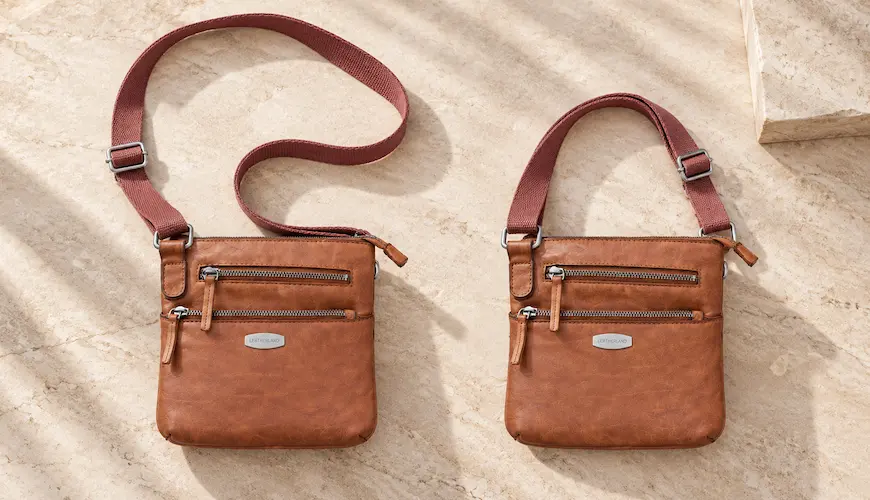
TL;DR: Choose the Carrying Method, Not Just the Bag Label
A crossbody bag has a strap worn diagonally across the body, with the bag on the opposite side. A shoulder bag hangs from one shoulder on the same side. Crossbody carry is useful when you want your hands free while moving; shoulder carry may suit you if you prefer a bag you can put on and take off without lifting a strap over your head.
Neither style is automatically more comfortable, roomier or more secure. The better choice depends on the strap fit, what you carry, the closure and your daily routine. Some bags can do both jobs.
Contents
- Crossbody vs shoulder bag: the main differences
- Which suits your daily routine?
- How to check strap length and fit
- Which carrying method is more comfortable?
- Keeping your belongings secure
- Check what fits, not just the bag's size
- Try the same bag in two carry modes
- A note on leather and clothing
- Making your choice
- Frequently asked questions
Crossbody vs Shoulder Bag: The Main Differences
The main difference is the route of the strap. Crossbody carry runs from one shoulder towards the opposite side of your torso. Shoulder carry keeps the strap and bag on the same side.
These names do not tell you how much a bag holds. A small shoulder bag may carry less than a roomy crossbody. Both can have secure zips, open sections or several compartments.
| Consideration | Crossbody carry | Shoulder carry |
|---|---|---|
| Strap position | Diagonally across the body to the opposite side. | Over one shoulder, with the bag on the same side. |
| Moving around | The strap crosses the torso, so it does not simply slide off one shoulder. Check bag swing and rubbing. | Can leave your hands free, but the strap may need repositioning if it slips. |
| Putting it on and taking it off | Usually involves lifting the strap over your head or opening suitable hardware. | Can be lifted directly on and off the shoulder. |
| Reaching your belongings | Check that the opening is easy to reach at your chosen height. | Check clearance under your arm and whether the opening is easy to use. |
| Capacity and appearance | Depend on the bag's dimensions, layout, material and design. | Depend on the bag's dimensions, layout, material and design. |
| Comfort and security | Depend on fit, packed weight, closure and how you carry it. | Depend on fit, packed weight, closure and how you carry it. |
If you already know which method you prefer, compare our women's leather crossbody bags and leather shoulder bags. Check each product's carrying options rather than assuming every style works both ways.
Which Suits Your Daily Routine?
For Errands, Shopping and Public Transport
Crossbody carry is worth considering when you regularly need both hands for shopping, a travel card, a coffee or other items. Adjust the bag so you can reach it without repeatedly moving the strap.
A shoulder bag can also work well, especially if you take it off frequently. The useful question is whether it stays in place while you move, not whether it belongs to the right category.
For Work and Commuting
Start with your work items. A phone, wallet and notebook make different demands from a laptop, charger, lunch and water bottle.
Neither a shoulder strap nor a crossbody strap guarantees laptop space or protection. Check the usable compartment and opening, including room for a sleeve. If either single-strap setup feels uncomfortable with your normal load, reduce what you carry or compare a suitable leather backpack.
For Travel and Days Out
Consider how often you will walk, sit down and reach for your belongings. Crossbody carry can keep a small bag close while your hands are occupied. Shoulder carry may be convenient when you want to remove the bag often.
For phone-first outings, leather phone purses offer another option. Check your phone with its case against the actual pocket or compartment, not just the bag's outside measurements.
For Work-to-Evening Use
Carrying method alone does not make a bag casual or dressy. Shape, finish, hardware and your outfit all contribute. A convertible design may let you change how you carry the same bag without moving your belongings into another one.
How to Check Strap Length and Fit
An adjustable strap is useful only if its adjustment range works for you. The longest setting must reach your preferred crossbody position; the shortest must suit shoulder carry if you want both options.
Strap Length Is Not the Same as Strap Drop
- Strap length is measured along the strap between stated endpoints. Check whether the measurement includes clips or other hardware.
- Strap drop is the vertical gap between the highest point of the hanging strap and the bag's top edge.
Do not compare these numbers as though they mean the same thing. Attachment positions and strap shape affect the result. If you already own a comfortable bag, compare its strap with the proposed bag using the same measurement method.
Allow for Your Body and Clothing
Height is only part of the fit. Torso shape, where the strap crosses your chest and the clothes you wear also affect where the bag rests. A strap that works over a thin top may feel different over a coat.
You should be able to walk, sit and reach the opening without the bag pulling awkwardly, catching under your arm or swinging excessively. There is no universal waist or hip position that suits everyone.
Which Carrying Method Is More Comfortable?
Fit and packed weight matter more than a promise that one style is always comfortable. Crossbody carry still uses a strap over one shoulder; it does not spread the load equally across both shoulders like a two-strap backpack.
A 2017 laboratory study of 20 healthy students found lower activity in two of four measured shoulder and back muscles during crossbody rather than same-side shoulder carrying. Participants stood for five minutes in each condition with a load equal to 10% of their body weight.
That is useful evidence that carrying position can change muscle demand. It is not proof of less pain during a full day, and the experimental weight is not a recommended handbag weight limit.
Before choosing, consider the bag's own weight as well as its contents. Notice whether the strap digs in, whether you keep lifting a shoulder to hold it in place, and whether carrying becomes uncomfortable. Remove unnecessary items rather than relying on a different strap to solve an excessive load. Seek professional advice if symptoms persist.
Keeping Your Belongings Secure
Tasmania Police recommends wearing bags across the body in crowded places to make them harder to snatch from the shoulder, and choosing secure zip or flap closures.
However, crossbody does not mean theft-proof. An open compartment, an unattended bag or an exposed pocket still needs attention. Victoria Police advises keeping bags zipped, visible and attended.
Check the compartment that holds your phone or wallet. A zipped main section does not mean every outside pocket is zipped, and an ordinary adjustable strap is not evidence of slash resistance or other specialist anti-theft features.
Check What Fits, Not Just the Bag's Size
Lay out what you carry on a normal day, then identify the largest or most awkward item. Include the phone case, filled wallet, glasses case or bottle you actually use.
- Check the opening as well as the main compartment.
- Look for interior photographs showing pockets and dividers.
- Make sure the closure can work without forcing it around the contents.
- Keep frequently used items accessible without emptying the bag.
External measurements do not prove that a particular phone or bottle fits inside. Ask for usable internal measurements if the listing does not provide enough detail.
One Bag Can Offer More Than One Carrying Option
Leatherland's Sera crossbody bag is described with an adjustable woven strap for shoulder or crossbody use. The Nora phone bag also lists both carrying options, with a different compartment layout.
These are examples of why the bag label is only a starting point. Check the current product details and available strap measurements to decide whether either configuration suits you.
Try the Same Bag in Two Carry Modes
If you have a suitable adjustable bag, compare shoulder and crossbody carry using the same contents. This is a practical buying check, not a medical test.
- Pack your normal essentials. Leave out items you rarely use.
- Adjust for shoulder carry. Check clearance under your arm and whether the strap stays in place without gripping it.
- Adjust for crossbody carry. Check where the strap crosses your torso and where the bag rests.
- Move as you normally would. Walk, sit down and bend to pick something up.
- Reach for your phone and keys. Notice whether access is awkward or requires repeated strap adjustment.
- Compare the results. Choose the configuration that feels practical with your clothes and contents. If neither works, reconsider the load or bag.
When buying online, use a familiar bag as your reference and ask for missing measurements. Do not assume a model photograph shows how the bag will sit on your body.
A Note on Leather and Clothing
Think about what the bag will rub against. Oroton's leather-care guidance notes that colour can transfer between dark clothing and light leather, or from some leather finishes to light clothing. This is a general care consideration, not a claim that every leather bag will transfer colour.
Follow the instructions for your bag's particular finish. Leather Naturally's care guide explains that different leathers need different care. Check suitability and patch-test a care product before applying it broadly.
Crossbody or Shoulder Bag: Making Your Choice
Choose crossbody carry if keeping the strap across your body helps you move and manage your daily essentials. Choose shoulder carry if you prefer direct on-and-off access and the strap sits securely without repeated adjustment.
If both methods suit different parts of your day, a well-fitting convertible bag may cover both needs. For help deciding how that bag fits alongside the ones you already own, read our guide to building a practical capsule handbag collection.
Compare Leatherland's leather crossbody bags and shoulder bags by strap options, compartments and what you need to carry. The right choice is the one that works when packed, not just when photographed.
Frequently Asked Questions
Why does my shoulder bag keep slipping off?
The strap length, shape or surface may not suit your shoulder or clothing. Check whether you can adjust it so the bag rests securely without lifting your shoulder or gripping the strap. If the bag supports crossbody carry, try that configuration with the same contents.
Should a crossbody bag sit at the waist or hip?
There is no single correct height for everyone. Adjust the strap so you can walk, sit and reach the opening comfortably without the bag rubbing or swinging excessively. Check the fit over the clothing you normally wear.
Does a wider strap make a heavy bag comfortable?
Not necessarily. Strap width is only one part of the fit. The strap's edges, material, position and the total packed weight also matter. A different strap is not a substitute for removing contents you do not need.
Can one leather bag work for both commuting and evenings?
It can, if its capacity, closure and carrying options suit both situations. Look for a bag that holds your normal contents and has a strap that adjusts to the positions you want. Do not assume every detachable strap also adjusts short enough for shoulder carry.