
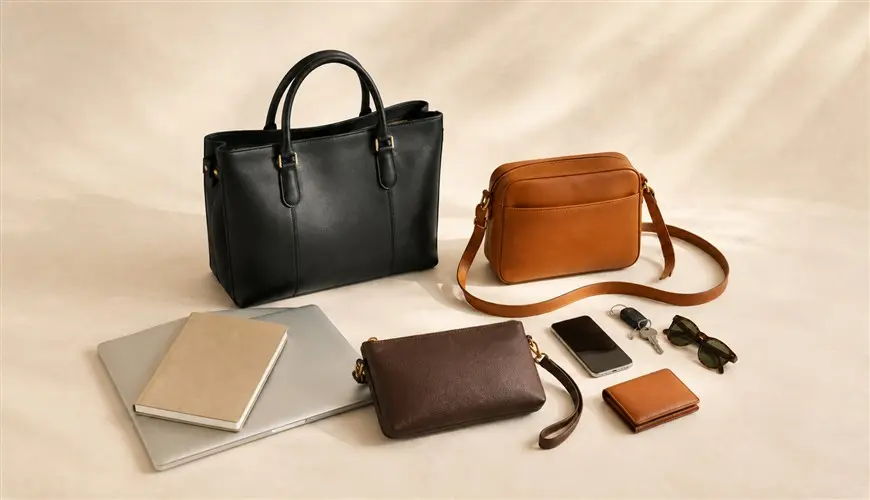
A useful handbag collection is not defined by a fixed number. It is the smallest group of bags that covers what you carry, where you go and how you prefer to carry it. For one person, that may be a crossbody and a tote. Another may need a work bag, a hands-free everyday bag and a compact option for events.
In short
Start with your real weekly routine, not a list of “must-have” styles. Give each bag a job, check that it fits your largest essential, and add another only when it changes at least two useful things: capacity, carrying method, closure, organisation or dress level. This role-gap test helps you cover more situations without buying near-duplicates.
What is a capsule handbag collection?
A capsule handbag collection is a small, deliberate set of bags that covers your recurring situations. The aim is functional coverage rather than collecting a prescribed tote, shoulder bag, crossbody, clutch and backpack.
A style belongs in your collection only if it solves a real carrying need. A tote may cover work and shopping if it has the right dimensions and closure. A convertible design may cover shoulder and backpack use. A compact crossbody may work for errands, sightseeing and casual evenings. Combining roles is useful; forcing one unsuitable bag to do everything is not.
1. Audit your routine and what you carry
Review a normal fortnight and list the situations in which you use a bag. Include only activities you actually do: commuting, office days, school runs, shopping, dinners, flights or weekend trips. Then write down what each situation requires.
| Question | Why it changes the choice | Example |
|---|---|---|
| What is the largest item? | It sets the minimum usable size. | Laptop, A4 folder, water bottle, glasses case or only a phone and wallet |
| Do your hands need to stay free? | It determines whether a crossbody strap or backpack carry is important. | Public transport, markets, travel or walking with children |
| How secure must the opening be? | A zip or other fastening may matter more in crowds and during travel. | Busy stations versus moving between the car and an office |
| How much organisation is needed? | Pockets can separate frequently used items, but they also divide the available space. | Work technology and cables versus a short essentials list |
| How long will it be carried? | Strap position and the final packed load become more important over time. | A ten-minute errand versus a full day of sightseeing |
| How formal is the setting? | The silhouette and finish may need to work with professional or event clothing. | Everyday errands, work meetings or a wedding |
This audit often shows that “work”, “everyday” and “travel” are not automatically three different bag needs. If the same bag fits the load, carry time, security and dress requirements, it can cover all three.
2. Use the role-gap test before adding another bag
When considering a new bag, compare it with the bag you already use most. Give one point for every meaningful difference:
- Capacity: it fits a load your current bag cannot, or avoids carrying excess space when you need very little.
- Carrying method: it adds a genuinely useful hands-free, shoulder, hand-held or backpack option.
- Closure: it provides a more suitable level of access or security.
- Organisation: its layout solves a repeated problem, such as separating a laptop, phone, keys or travel documents.
- Dress level: it works in a setting where your current bag looks too casual or too formal.
The two-difference rule: a new bag should normally improve at least two of these areas. A bag that changes only the colour while repeating the same size, carry style and layout may add variety, but it does not fill a functional gap. This is a decision aid, not a product-quality score; personal style can still be a valid reason to own something.
3. Choose bag roles that match your life
Bag names are useful starting points, but the role matters more than the label. Check the actual dimensions, opening, strap and compartments of any product you consider.
| Role | Often suited to | Check before buying | When it may be unnecessary |
|---|---|---|---|
| Hands-free everyday bag | Crossbody bag or convertible shoulder bag | Phone fit, strap adjustment, zip access and space for your usual wallet | Your existing shoulder or backpack bag already carries comfortably hands-free |
| Work or high-capacity day bag | Leather tote, larger handbag or structured shoulder bag | Laptop or folder dimensions, opening width, closure and handle drop | You work lightly and your everyday bag fits every required item |
| Long-carry or commute bag | Leather backpack, crossbody or convertible style | Packed comfort, strap position, access and whether the load stays balanced | Your trips are short and a shoulder bag remains comfortable when packed |
| Compact event bag | Clutch or compact crossbody | Phone dimensions, key bulk, closure and whether a removable strap adds useful flexibility | Your small everyday bag already suits the dress level |
| Dedicated travel bag | Secure crossbody, backpack or travel carryall | Carrier size rules, closure, documents, water bottle, electronics and hours of carry | Your everyday and luggage combination already covers the journey |
If you are unsure which style matches a role, start at the women’s leather bags and wallets hub and compare the relevant category rather than assuming every bag with the same name has the same capacity.
4. Check fit, access and comfort
Measure the item, the opening and the internal space
External bag measurements do not guarantee that an item will pass through the opening or fit inside the lined compartment. Measure the length, height and depth of your largest essential. For a laptop or tablet, include the protective sleeve. Then compare those measurements with the product’s usable internal dimensions and opening, if supplied.
If only external dimensions are listed, treat the fit as unconfirmed and ask before buying. Structured sides, zip curves, seams, padding and internal dividers can reduce usable space. A water bottle also needs upright depth, not just enough total volume.
Test the complete packed load
Comfort cannot be judged from the empty bag alone. Pack the items you expect to carry and consider where the strap sits, whether handles fit over your clothing, how the weight is distributed and how easily you can reach your phone or keys. There is no universal “comfortable” weight because the load, carrying time, strap design and person all differ.
Make switching bags easier
Keep repeat essentials together in a small pouch and use a wallet that fits every bag in the collection. This reduces forgotten items and makes a two- or three-bag collection easier to use. Browse women’s leather wallets and purses if your current wallet is the item preventing you from using a compact bag.
5. Compare colour, leather and construction
Choose colour from your real wardrobe
There is no neutral colour that works for everyone. Look at the shoes, belts, outerwear and metal finishes you wear most. A dark bag may move easily between work and evening use; tan or brown may suit a casual wardrobe; a distinctive colour can be useful when the rest of the collection is restrained. Colour earns a role when it makes the bag more usable with your clothes, not because a generic capsule list says it is essential.
Check the whole bag, not only the leather label
“Genuine leather” describes material composition at a broad level; it does not tell you the bag’s capacity, finish, lining, hardware or construction quality. Review the product description and photos for:
- consistent stitching at seams and load-bearing points;
- secure handle and strap attachments;
- zips or fastenings that suit the intended use;
- a lining and pocket layout that are accessible rather than merely numerous;
- feet or a reinforced base if the bag will regularly be placed on the floor; and
- care instructions appropriate to that particular leather and finish.
What a one-, two-, three- or four-bag collection can cover
These are examples, not shopping rules. Start at the smallest level that covers your routine and expand only when the audit reveals a gap.
| Collection size | Possible combination | Best suited to | Likely gap |
|---|---|---|---|
| One bag | Medium crossbody, shoulder bag or convertible design | A consistent daily load and similar dress settings | Very small events or large work/travel loads |
| Two bags | Hands-free everyday bag + larger tote or backpack | Most daily errands plus work, study or commuting | Formal events, if neither bag suits them |
| Three bags | Everyday crossbody + larger work bag + compact event bag | Daily, professional and occasional-event needs | Dedicated overnight or specialist travel use |
| Four bags | Everyday + work + event + dedicated travel role | People whose travel load differs materially from daily carry | None, unless a repeated specialist activity is still uncovered |
Care and storage
Follow the care instructions supplied for the specific product and leather finish. The Leather Working Group recommends asking the retailer or brand when product-specific care instructions are not supplied.
For general care, remove loose contents before storage, avoid crushing the bag and keep it away from direct heat and prolonged sunlight. If leather becomes wet, let it dry naturally rather than using a hairdryer, radiator or direct sun. Test any suitable leather-care product on a hidden area first; these precautions are also included in Leather Naturally’s care guidance.
Rotate bags because the role requires it, not simply to “rest” leather for a fixed period. Emptying receipts, cosmetics and loose items between uses also makes the collection easier to audit.
Capsule handbag buying checklist
- Name the situation the new bag must cover.
- List the exact items it must hold and measure the largest one.
- Decide whether hands-free carry, a secure closure or a formal appearance is essential.
- Compare usable internal space and opening dimensions, not only external size.
- Pack a similar bag to judge the likely loaded comfort.
- Apply the two-difference rule against your closest existing bag.
- Check construction, attachments, hardware, lining and care instructions.
- Choose a colour that works with clothes you already wear.
- Wait if the bag does not fill a clearly named gap.
When you are ready to compare options, browse Leatherland’s women’s leather handbags by the role you identified. The goal is not to own every style. It is to choose bags that make everyday carrying simpler.
Frequently asked questions
How many handbags should be in a capsule collection?
There is no fixed number. Start with one bag if it covers your routine. Add another when it solves a repeated gap in capacity, carrying method, closure, organisation or dress level. Two or three well-separated roles may be enough for many routines.
Which handbag should I buy first?
Choose the bag that covers your most frequent situation. Measure what you carry on a normal day, decide whether you need hands-free carry and check the closure and internal space. Do not begin with a formal or travel bag unless that is genuinely your most common need.
Can one bag work for both work and everyday use?
Yes. One bag can cover both roles if it fits your work items, remains comfortable when packed, has suitable access and looks appropriate in both settings. You do not need a separate work bag just because capsule lists commonly include one.
How do I avoid buying duplicate handbags?
Compare the proposed bag with your closest existing one across capacity, carrying method, closure, organisation and dress level. If it does not meaningfully improve at least two areas, it is probably adding style variation rather than filling a functional gap.
Is a tote or crossbody better for everyday use?
A tote generally suits a larger load, while a crossbody is often chosen for hands-free carry. The better option depends on your largest item, carrying time, preferred closure and whether the packed weight remains comfortable.