

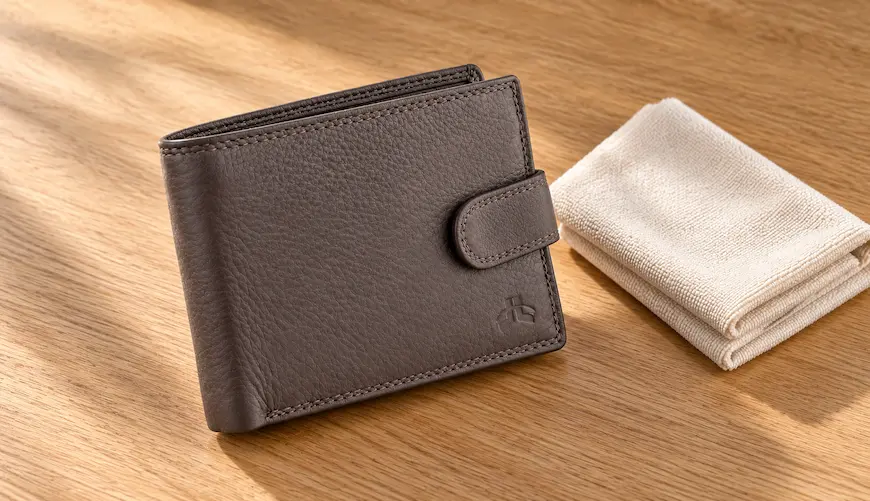
TL;DR: How to Make a Leather Wallet Last Longer
Carry only what fits without forcing the slots or closure, remove dirt gently, and keep your wallet away from prolonged heat and damp. If it gets wet, empty it, blot away surface water and let it dry naturally. Use a cleaner or conditioner only when it suits the leather finish and the maker's care instructions.
A wallet does not need to look new to remain useful. The aim is to prevent avoidable damage, not remove every crease or keep adding products until the leather feels softer.
Contents
- Why leather wallets wear out
- Check the leather before treating it
- Everyday habits that reduce wear
- How to clean a leather wallet
- Does your wallet need conditioner?
- What to do when a wallet gets wet
- Heat, humidity and storage
- Patina, damage and repair
- A simple care checklist
- How long should a leather wallet last?
- The most useful care habit
- Frequently asked questions
Why Leather Wallets Wear Out
A wallet bends whenever you open it. Its corners rub against pockets and bags. Cards press against the slots, while coins and receipts can add weight and bulk. Over time, the leather, stitching, lining and closure may wear in different ways.
That is why care involves more than wiping the outside. A clean wallet can still be overloaded, and soft leather can still have a damaged seam.
Leather gets much of its structure from collagen, a network of protein fibres in the hide. Tanning treats that hide to make it more stable and useful. It does not make the finished material immune to water, chemicals, rubbing or ageing.
In a 2019 study of leather stiffness, researchers found that moisture affected the spacing between collagen molecules and how easily the leather bent. In simple terms, moisture changes how the material moves. That is not a reason to wet a stiff wallet: flexibility and resistance to damage are different things.
For everyday care, start with three questions: does the wallet close comfortably, is it clean and dry, and are any parts beginning to fail?
Check the Leather Before Treating It
Before using a cleaner, cream or spray, read the care information supplied with your wallet. If it does not identify a suitable treatment, ask the seller or maker rather than testing a household remedy.
The surface finish matters. A smooth, coated wallet may react differently from leather with little surface protection, even when both are described as genuine leather.
| Leather or finish | What it means | Care consideration |
|---|---|---|
| Pigmented leather | A coloured finish covers the surface. | Choose a method suitable for that finish; do not assume household cleaners are safe. |
| Aniline leather | Leather coloured with dye and without a covering pigment finish. | It absorbs liquids more readily and can darken after treatment. |
| Suede or nubuck | Leather with a soft, raised surface called a nap. | Do not use a smooth-leather cream unless specifically approved. |
| Unknown finish | The product information does not explain its surface treatment. | Check before applying moisture, oils or protective products. |
Leather Naturally's care guide explains these differences and recommends testing treatments on a hidden area. It is industry guidance, developed with a leather-care specialist, rather than a test of wallet lifespan.
Full-grain does not mean waterproof or untreated. A grain description alone is not enough to choose a cleaning product. Also consider the lining, edge coating, thread and any other materials inside the wallet.
Everyday Habits That Reduce Wear
Stop forcing extra contents into tight spaces
If you need to squeeze the wallet shut, remove something before fastening it. Check for old receipts, expired cards and coins that have collected in the wrong compartment.
The Canadian Conservation Institute's leather guidance warns that overstuffing leather objects can stretch the material and stress stitching. Applying that principle to a wallet is sensible, although it does not tell us how many extra cards will cause damage.
A card-slot count describes a layout, not permission to keep filling the wallet until nothing else fits. Cards vary in thickness, and hidden pockets are not necessarily extra card slots.
For example, our Kalang SleekEase slim wallet has four dedicated card slots in our catalogue audit. The Upscale wallet lists 14 card slots and a separate ID window. They serve different carrying needs; neither figure is a tested maximum load.
If your regular contents no longer fit, a different layout may be more useful than stretching the existing wallet further. Our guide to choosing a men's leather wallet explains how to compare capacity without buying unnecessary bulk.
Keep sharp objects and unnecessary pressure away
Give the wallet its own space where practical. Loose keys and other hard objects can catch on a surface or seam. In a bag, avoid leaving it underneath heavy items.
If you keep it in a back pocket, take it out before long periods of sitting. This is a simple way to avoid prolonged compression, not a proven formula for adding years to its life. Choose a secure place for it rather than leaving it unattended on a seat or table.
Use the fold and closure as intended
Open the wallet along its existing fold. Do not bend it backwards to flatten it, pull a stuck zip harder, or tug repeatedly at a press stud that no longer lines up. Remove contents and check what is causing the strain.
During a quick clean, look at the fold, corners, slot openings and seams. A loose thread or small split is easier to assess before you continue pulling on the area.
How to Clean a Leather Wallet
Start with the least treatment needed. A little surface dust does not call for a deep clean. A stain that resists gentle cleaning does not call for harder rubbing.
The Western Australian Museum identifies abrasive dirt, vigorous cleaning and rough handling as sources of leather damage. Its advice concerns collections, but the reason for removing grit carefully is relevant to everyday use too.
- Empty the wallet. Take out cards, notes, coins and loose papers so you can reach the compartments without pulling them wide.
- Remove loose dirt. Use a clean, soft, dry cloth. Work gently around seams and slot openings rather than pushing debris further inside.
- Read the care instructions. Check whether a slightly damp cloth or a particular leather cleaner is suitable. Do not move straight to wet cleaning on an unknown finish.
- Patch-test any approved treatment. Try a small, less visible area and allow it to dry before deciding whether to continue.
- Treat lightly. If a damp cloth is permitted, wring it out well. If using a compatible cleaner, follow its directions and avoid soaking seams or the lining.
- Let the wallet dry before reloading it. Check inside the compartments, not just the outside surface.
Stop if colour lifts unexpectedly, the finish becomes sticky, the surface roughens or the mark spreads. Do not keep adding cleaner to correct a reaction caused by the first application.
What about ink, grease and other stubborn stains?
A stain may have travelled beneath the surface, or the mark may be damage to the finish rather than dirt sitting on top. Those are different problems.
Do not work through a list of alcohol, vinegar, dishwashing liquid and oil until something changes. For an unfamiliar stain, ask for advice and explain what caused it, when it happened and what has already been applied. Include a clear photograph if possible. A specialist may be able to improve it, but complete removal is not guaranteed.
Does Your Leather Wallet Need Conditioner?
Possibly, but not automatically. A conditioner is a treatment intended to change how leather feels or behaves; it is not a repair for broken stitching or torn material.
Some functioning leather goods benefit from suitable treatments. Others have finishes for which a particular cream or oil is inappropriate. Begin with the maker's advice, then the product label.
The US National Park Service's review of leather dressings describes problems from oils and waxes, including darkening, sticky residues and fatty deposits. It also distinguishes preservation of historic objects from maintaining personal goods still in use. Its museum advice should not be read as a blanket ban on conditioning every modern wallet.
How to approach conditioning cautiously
- Confirm the treatment is suitable for your wallet's finish.
- Use it on clean, dry leather, unless its instructions say otherwise.
- Patch-test and assess the dried result, including any colour change.
- Follow the stated amount and application method rather than adding extra.
- Keep it away from materials it is not designed to treat, such as fabric lining or clear ID windows.
There is no universal rule that every wallet needs conditioner once a month or every three months. Inspection can be regular; treatment should depend on the item and its instructions.
Can conditioner fix cracked leather?
Do not assume that a softer surface means a crack has healed. A treatment might improve feel or appearance without reconnecting torn fibres.
Research published in Heritage Science in 2024 found structural changes in vegetable-tanned leather after accelerated heat, UV and chemical ageing. These were laboratory samples, not wallets in daily use. The useful lesson is limited: hardening can involve deeper damage, so adding cream is not always the answer.
What to Do When a Leather Wallet Gets Wet
Whether it was rain, a spill or an accidental wash, deal with the moisture before returning the wallet to a pocket or drawer.
- Empty it promptly. Separate wet cards, notes and receipts from the compartments.
- Blot surface water. Use a clean, soft, absorbent cloth. Press gently rather than scrubbing or wringing.
- Let air reach the inside. Open the wallet only as far as its normal fold allows. Do not stretch it flat or force tight sections apart.
- Dry it naturally in a shaded, ventilated place. Keep it away from a hairdryer, heater and direct sun.
- Check it before reuse. Look for damp lining, distorted compartments, colour changes or new stiffness. Seek advice if it has changed substantially.
Natural drying away from direct heat is part of Leather Naturally's care recommendations. There is no reliable drying time for every wallet: thickness, lining, how wet it became and surrounding conditions all matter.
Do not apply oil to a wet wallet in an attempt to seal in moisture. Let it dry and assess its condition before considering any maker-approved treatment.
For an RFID wallet, do not assume that a dry-looking exterior proves every internal layer is unaffected. RFID refers to a feature that helps limit certain radio-frequency reading; it is not a waterproof rating. Ask the maker if the wallet has been soaked or washed.
Keep It Away From Prolonged Heat and Damp
A sunny dashboard is not a useful drying rack. Nor is a damp gym bag a good place to leave a wallet between uses.
The Western Australian Museum's preventive guidance advises protecting leather from direct sunlight and avoiding sharp, imposed folds. For a working wallet, that means choosing a shaded storage spot and letting it rest in its normal shape, without heavy objects on top.
For longer storage, empty it and make sure it is dry first. Use a clean place that protects it from dust without trapping dampness. Check it occasionally rather than packing it away and forgetting it.
Why humidity matters
Relative humidity describes how much water vapour the air holds compared with what it could hold at that temperature. High humidity means the air is close to being saturated, which can make damp items harder to dry.
The Canadian Conservation Institute gives the following approximate mould-onset estimates for susceptible organic materials under warm conditions around 25°C:
| Sustained relative humidity | Approximate time before visible mould |
|---|---|
| 70% | 100 days |
| 80% | 10 days |
| 90-100% | 2 days |
Leather finish, temperature, dirt and length of exposure affect the risk. These figures are not safe waiting periods. The practical point is to deal with dampness promptly instead of sealing a wet wallet away.
Learn the Difference Between Patina and Damage
Patina is the gradual change in appearance that some leather develops with use. It may include a softer sheen, a richer tone or familiar wear marks. Not every wallet develops it in the same way.
A normal fold line is different from a split that opens when the wallet bends. Look at whether the material remains intact and the wallet still works as intended, rather than judging by age or colour alone.
| What you notice | What to consider | What to do |
|---|---|---|
| Gradual tone change or a soft sheen | May be ordinary use or patina, depending on the finish. | Do not aggressively clean it simply to recover the original colour. |
| Deep crack, tear or opening seam | May involve structural damage. | Reduce strain and ask for a repair assessment. |
| Peeling or flaking | The coating, finish or material underneath needs checking. | Do not assume cream will repair it or that appearance alone proves the material type. |
| White deposits | Could be dirt, salts, fatty deposits or mould. | Seek advice if the cause is unclear, especially after damp storage. |
| Stickiness after treatment | Could be residue or a reaction with the finish. | Stop adding products and explain what was applied when seeking help. |
The National Park Service explains that white fatty deposits, sometimes called spew, can resemble mould. Colour alone is not enough to identify the cause. Do not use a hairdryer or solvent as a home diagnosis test.
When repair is worth investigating
If the wallet otherwise suits you, ask about a loose seam, damaged lining or closure before replacing the whole item. Repair depends on the location, materials and condition; some problems are straightforward, while others are not practical to fix.
Take photographs and note whether the fault is spreading. Avoid covering the area with glue or oil before assessment, as that may make the original problem harder to judge.
If a slot no longer holds cards securely or a closure fails, do not rely on it for valuables while deciding what to do next.
A Simple Leather Wallet Care Checklist
You do not need a shelf of products. Link the routine to what has happened to the wallet.
| When | Useful action |
|---|---|
| It starts feeling overfull | Remove unused contents and check that it closes without force. |
| You notice loose dirt | Empty it and clean gently, starting dry. |
| It gets wet | Empty, blot and air-dry away from heat. |
| You consider a care product | Check compatibility and patch-test before wider use. |
| You are putting it away | Store it clean, dry and without pressure on its shape. |
| A seam, slot or closure changes | Stop forcing it and assess the problem. |
How Long Should a Leather Wallet Last?
There is no useful single lifespan for every leather wallet. Materials, finish, construction, contents, daily handling and accidents all affect the outcome.
The research behind this guide does not establish that a care routine adds a particular number of years. Laboratory ageing studies and museum preservation guidance help explain damage, but they cannot predict the life of the wallet in your pocket.
Judge it by function: does it hold your cards securely, close properly and remain intact at the folds and seams? A worn-looking wallet may still work well. A newer one with a failing slot may need attention sooner.
The Most Useful Care Habit Is Paying Attention
Remove what you do not need, deal with water and dirt before putting the wallet away, and notice small faults before continuing to strain them. Treat the leather when there is a good reason and a compatible method, not simply because another month has passed.
If your carrying needs have changed, compare our men's leather wallets by their actual compartments and layout. A wallet that fits your everyday contents is more practical than repeatedly forcing those contents into one that does not.
Frequently Asked Questions
Can I use olive oil, coconut oil or hand cream on a leather wallet?
Avoid unapproved household substitutes. Their ingredients may change the colour or leave residue, and suitability varies by finish. Use only a treatment compatible with the wallet and its care instructions.
Should I condition a new leather wallet straight away?
Not unless its care instructions recommend it. A new wallet does not automatically need extra treatment, and an unsuitable product may alter its finish.
Can I wash a leather wallet in a washing machine?
Do not machine-wash it unless the maker explicitly allows it. Leather, lining, coatings and other components may need different care. If it has already been washed, empty it, blot it gently and let it dry naturally before assessing the damage.
Can I use baby wipes or disinfectant wipes?
Do not assume they are suitable for leather. Ingredients and finishes vary. Check the wallet maker's advice, and do not confuse surface cleaning with a verified disinfection method.
Will stretched card slots shrink back?
Do not rely on them returning to their original fit. Avoid heat, soaking or extra oil as a home shrinking treatment. If cards slip out, stop using that slot and ask about repair or replacement.
Does full-grain leather need a different care routine?
The full-grain label alone is not enough to decide. Check the surface finish and the maker's instructions before choosing a cleaner, conditioner or protective treatment.
How often should I check my wallet for wear?
Check it when removing receipts or cleaning it, and after a spill or soaking. Focus on the fold, card slots, seams and closure. This is a practical inspection habit, not a fixed treatment schedule.