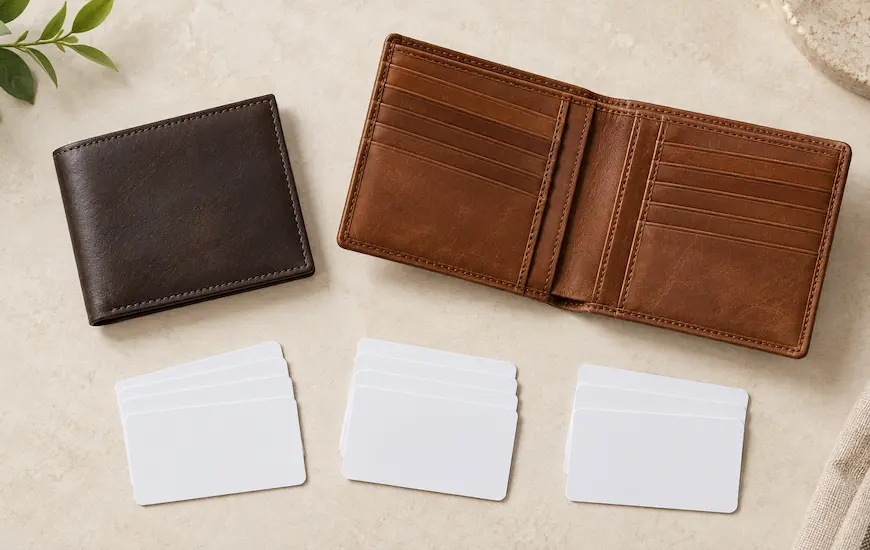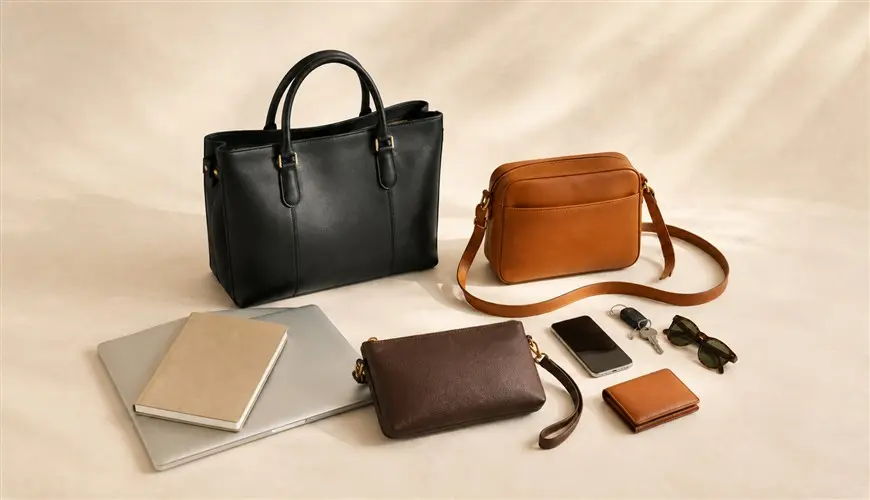

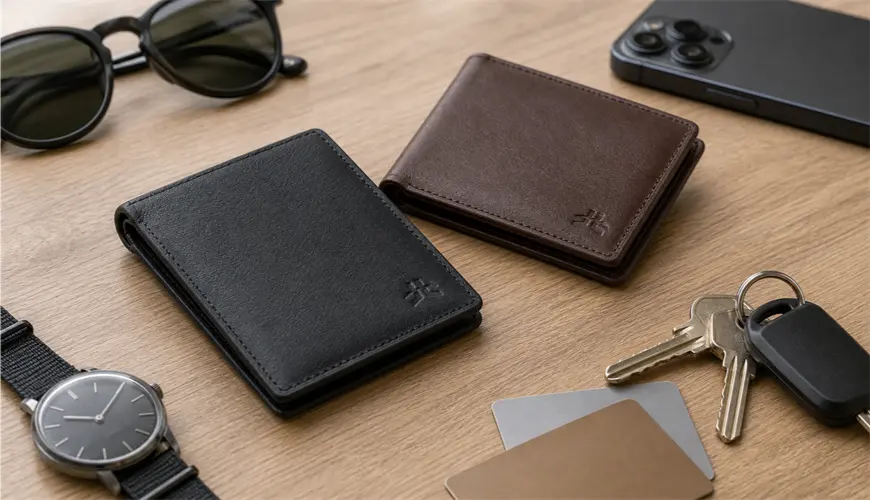
The right men’s wallet is the one that gives your regular cards, notes, ID and other essentials a clear place without adding storage you will not use. Empty your current wallet, remove anything you rarely need, count the remaining cards, and then decide whether you need cash, coins, an ID window, receipts or travel documents.
Choose capacity first. Choose the wallet style second. Treat leather type, colour and RFID protection as final filters—not as substitutes for a layout that works.
| What you regularly carry | Useful starting point | Check before buying |
|---|---|---|
| A small set of cards and occasional folded notes | Card wallet or slim wallet | Physical card slots, note storage and listed closed dimensions |
| Cards, unfolded notes and a few everyday extras | Bifold wallet | Slot layout, note sections, ID window and coin storage |
| Many cards, IDs, receipts or separated storage | Large-capacity wallet or trifold wallet | Physical slot count, compartments, closure and listed dimensions |
| Coins as well as cards and notes | Wallet with a coin section | Coin-section closure and what other storage remains available |
| Passport, travel documents or more than everyday carry | Passport wallet | Passport fit, document sections, closure and overall size |
These are starting points, not universal capacity rules. Wallets within the same style can have very different layouts, so check the individual product details.
Do not begin with “bifold or trifold?” Begin with the objects the wallet must carry. Put everything from your current wallet on a table and sort it into six groups:
Now remove expired cards, old receipts and anything you do not use in a normal week. What remains is your working carry. This matters because buying for everything that has accumulated in an old wallet can lead you to a larger replacement than you actually need.
If your travel carry is much larger than your daily carry, consider two different tools: an everyday wallet and a separate passport or travel wallet. One wallet does not have to solve every situation.
Leatherland analysed 780 exported review records. After duplicate review text was identified, 427 unique review bodies remained. The recurring choice problems were practical: not enough card space, poor organisation, unnecessary bulk, coin and note storage, RFID convenience and uncertainty when buying a wallet as a gift.
“I have been looking for a long time to find a wallet that had more card spaces.”
“My existing wallet never had enough space for cards... now every card can have its own slot.”
The lesson is not that everyone needs more slots. It is that the layout should solve the buyer’s actual problem. Someone carrying four essential cards has a different job for a wallet than someone carrying fourteen cards, multiple IDs, notes and receipts.
Leatherland’s catalogue audit counts purpose-built physical card slots. Hidden pockets, note sections and ID windows are recorded separately. A physical-slot count is not a tested maximum capacity: card thickness varies, shared pockets may behave differently and every added item changes the loaded wallet.
Use the number of physical slots to compare layouts consistently. Do not assume that a spare compartment is another dedicated slot, and do not plan to double up cards unless the product information specifically supports it.
| Leatherland example | Audited physical card slots | Other listed storage | Approximate listed closed size | Best starting use |
|---|---|---|---|---|
| Kalang SleekEase slim RFID wallet (MW-001d) | 4 | 2 internal compartments and 2 note pockets | 10.5 × 7.5 cm; depth not supplied | A smaller set of cards with note storage |
| Upscale large-capacity RFID wallet (MW-021) | 14 | 1 ID window, 5 hidden pockets and 3 note sections, including 1 zipped section | 12 × 10 × 3 cm | More cards and separated everyday storage |
Method note: details come from Leatherland’s catalogue audit. Dimensions are approximate listed closed dimensions, not independent measurements or loaded-pocket tests. RFID protection is stated for both models.
This comparison shows why “slim” and “large capacity” should not be treated as two versions of the same promise. One prioritises a smaller card set. The other gives more items dedicated places. If neither example matches your carry, compare the full men’s leather wallet range by layout and features.
A bifold opens across two main sections. It is a useful general-purpose format when you want cards and a full-length note section without moving automatically to a specialist travel or zip-around design. Bifolds range from pared-back layouts to high-capacity versions, so the fold alone does not tell you the slot count.
A trifold opens across three sections. The extra panel can create more separated storage, but it also adds another folded layer. Compare the actual dimensions, compartments and card slots rather than assuming every trifold holds more than every bifold. For the detailed trade-offs, use the bifold versus trifold wallet guide.
A slim or card wallet makes sense when you are willing to limit what you carry. Check whether it holds notes flat, folded or not at all. Also check whether the advertised capacity refers to dedicated slots or shared storage. Slim describes the intended form; it does not guarantee how the wallet will feel after you load it.
A money clip wallet combines card storage with a clip for notes. It suits buyers who want quicker cash access without a full note compartment. Compare the clip mechanism, card slots and whether you are comfortable folding notes.
A zip-around wallet encloses the contents behind a zip. A chain wallet adds a physical tether. These features solve different problems: a zip helps retain loose contents, while a chain helps keep the wallet attached. Neither tells you the internal capacity, so inspect the layout separately.
Card count gets the attention, but the other contents often decide whether a wallet works.
Every extra pocket has a cost in layers and space. Choose the features you will use rather than the longest feature list.
RFID protection is available on selected Leatherland wallets. Treat it as a secondary filter after capacity and layout. If you want the feature, use the men’s RFID wallet range and confirm it on the individual product page.
Do not assume that every leather wallet includes RFID protection, and do not treat RFID as protection against losing the wallet, card theft or every form of payment fraud. A wallet still needs to organise your real daily carry.
Leather terms describe the material and how its surface has been treated; they do not tell you the card capacity, stitching quality or usefulness of the layout.
The Leather Working Group’s terminology reference, aligned with ISO, UNECE and CEN definitions, defines full-grain leather as leather that keeps its entire grain without surface removal by corrective mechanical treatment. Corrected-grain leather has part of the grain removed by buffing or a similar treatment and is then enhanced with a finish.
That distinction is more useful than treating every label as a simple “best to worst” ladder. When comparing two wallets, read the stated leather type, but also compare the design, lining, edges, stitching, closures and verified storage. A full-grain label does not fix a layout that is wrong for you.
You cannot fully assess a wallet from one closed product photo. Before buying, look for:
Be cautious when a listing uses words such as “slim,” “large,” “premium” or “high capacity” without supporting dimensions or storage details. Specific facts are more useful than adjectives.
A wallet can be a practical gift, but guessing from colour alone is risky. The safest approach is to study the wallet he already uses.
Leatherland’s review analysis repeatedly found gift buyers solving a real capacity problem. That makes “Does this fit what he carries?” a better gifting question than “Which wallet looks most impressive?”
Before you buy, make sure you can answer these questions:
If you know the style you need, go directly to the matching category above. If you are still comparing several layouts, browse all men’s leather wallets and use the product specifications to narrow the range.
No. For a consistent comparison, count only purpose-built physical card slots. Record hidden pockets, note sections and ID windows separately unless the product explicitly describes them as card storage. A slot count should not be presented as the wallet’s tested maximum capacity.
Use the listed closed dimensions to compare the basic format, but remember that cards, notes, coins and receipts change the loaded size. An empty measurement cannot prove how the wallet will fit or feel once filled.
Look for a purpose-built coin section with a closure and enough separate storage for receipts. Then check how many dedicated card and note sections remain, because the presence of a coin pouch does not guarantee the rest of the layout suits you.
Match the recipient’s current fold, count the occupied card slots, check whether he uses cash, coins or an ID window, and identify his main complaint. Choose more capacity only when lack of space is the problem; choose a slimmer option when unused bulk is the problem.
No. Full grain describes the leather’s grain surface, not the wallet’s capacity or construction. Use the material description together with the physical slot count, compartments, dimensions, stitching and closure details.



Add your favourites to cart

Select Afterpay at checkout

Log into or create your Afterpay account, with instant approval decision
Your purchase will be split into 4 payments, payable every 2 weeks
All you need to apply is to have a debit or credit card, to be over 18 years of age, and to be a resident of country offering Afterpay
Late fees and additional eligibility criteria apply. The first payment may be due at the time of purchase
For complete terms visit afterpay.com/terms