
There is no single ideal number of card slots. The right number is the number of physical cards you genuinely need to carry, with a dedicated place for each card you want to access separately. Count those cards first. Then check cash, coins, ID and receipts as separate storage requirements.
Do not compare a wallet’s headline “card capacity” with another wallet’s physical slot count as if they mean the same thing. Leatherland counts purpose-built card slots separately from ID windows, hidden pockets, note sections and coin pouches. We also do not assume that two cards belong in one slot unless the product description says so.
| Your counted physical cards | Useful place to start | What to check next |
|---|---|---|
| 1–4 | Card wallet or slim wallet | Whether you also need a note pocket |
| 5–8 | A wallet with at least your verified slot count | Slot access, ID storage and listed dimensions |
| 9–12 | A roomier bifold, trifold or organiser layout | Whether extra panels, a closure or coin storage suit you |
| 13–16 | Large-capacity wallet | How cards, IDs, notes and hidden storage are separated |
| 17+ | A purpose-built high-capacity layout | Physical slot evidence, closure and complete closed dimensions |
These are selection bands based on your own card count, not claims about what most people carry or what every wallet style can hold.
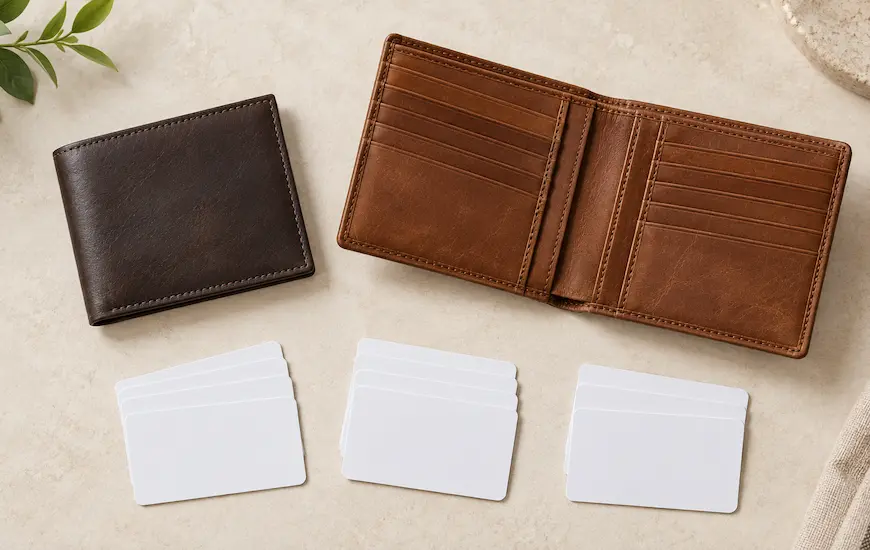
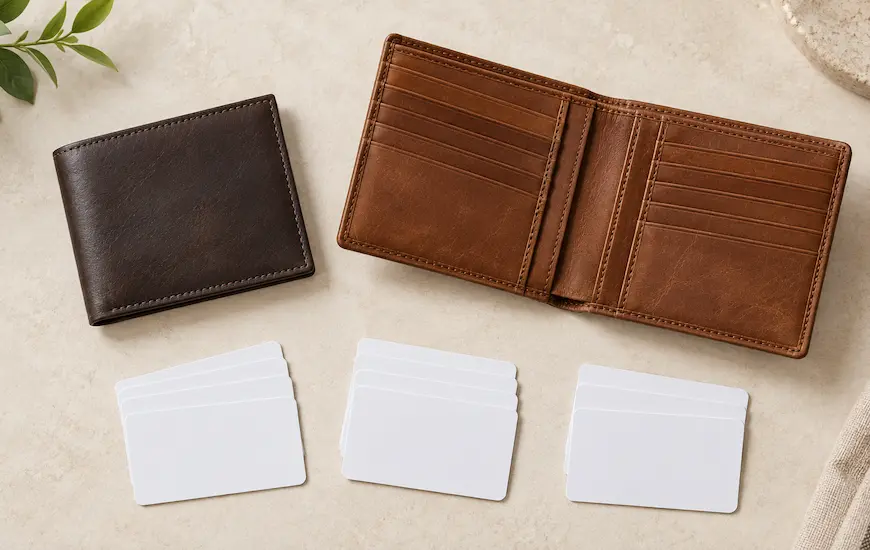
A physical card slot is a purpose-built opening designed to hold a card. That is the most useful number for comparing wallets because it describes a visible part of the layout.
Other storage should be reported separately:
This distinction matters. A wallet can have four physical slots and additional compartments, but that does not turn those compartments into four more dedicated slots. It can also have an ID window or a note section that solves a real storage need without changing the physical slot count.
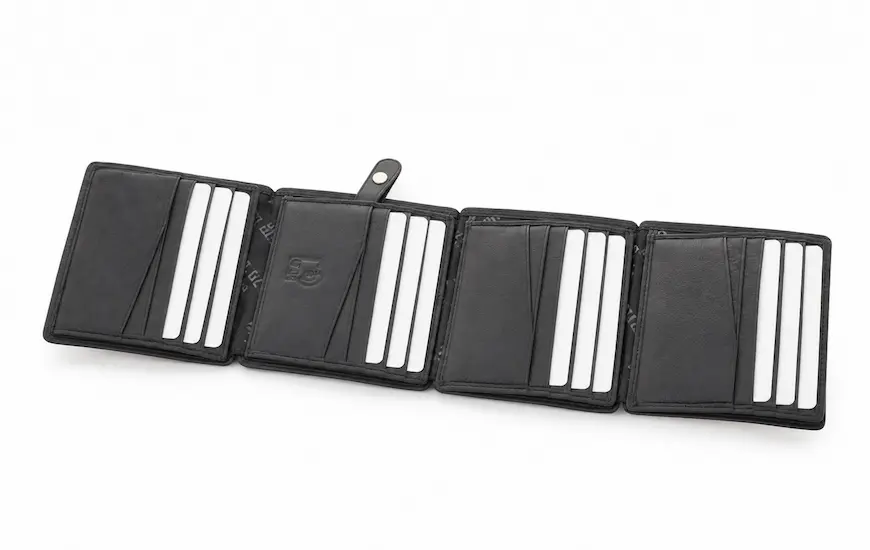
Empty your wallet and make three groups. This gives you a more reliable number than copying the contents of an overfilled old wallet into a new one.
These are cards you use regularly or must keep physically available. Depending on your circumstances, the group may include a driver licence or other ID, payment cards, a workplace access card, a physical transport card, a health card or a trade credential.
These are not used every day, but there is a clear reason to carry them. Examples include a backup payment card, a membership card that must be presented physically, or a card required for a recurring appointment or work task.
Check for expired cards, duplicates, old business cards, spent gift cards and loyalty cards you never present. If an issuer provides an official digital version, consider it only after confirming that it is accepted where you use it. Do not assume that a photograph or unofficial phone copy replaces a required physical ID.
Add groups one and two. That total is your starting number of physical card slots. If you want every card visible and independently accessible, look for at least that many verified dedicated slots.
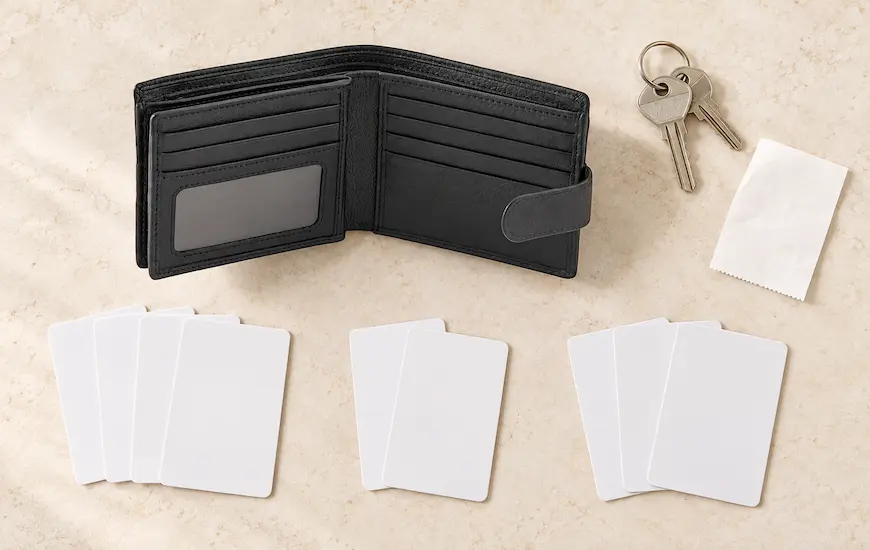
The bands below are not universal lifestyle labels. They simply turn your audited card total into a practical shopping path.
If your audit leaves four or fewer cards, compare a card holder with a compact folding wallet. The deciding question is often not card capacity but what else you carry. A card-only design may be enough if you rarely carry cash. A slim folding wallet can add note storage while keeping a small dedicated slot count.
At this count, check whether the cards sit in separate slots, stacked pockets or a mix of dedicated and shared storage. Think about which cards you use most often. A layout that makes the first four easy to reach may be more useful than one that hides every card behind another panel.
This range often brings more panels and compartments into the decision. Check whether you actually need ID windows, a coin pouch, a zip section or several note sections. Those features can be useful, but they are separate from the card count and change the overall layout.
If every card survived your audit, a dedicated large-capacity wallet may be the more honest choice than forcing a smaller design to do the job. Look for a clearly stated physical slot count, a sensible division between frequently and occasionally used cards, and a closure that suits the design.
At higher counts, broad words such as “large” and “organiser” are not enough. Look for open product photography and a description that states the physical slots separately from ID, hidden, cash and coin storage. Complete closed dimensions are also more useful than an adjective such as “slim”.
Leatherland audited the product descriptions behind the following wallets. The table uses the number of purpose-built physical card slots stated in the product information. It does not add ID windows, hidden compartments or note sections to that number.
| Wallet | Physical card slots | Other verified storage | Approximate listed closed size | Useful starting point |
|---|---|---|---|---|
| Kalang SleekEase (MW-001d) | 4 | 2 hidden compartments; 2 note pockets | 10.5 × 7.5 cm; depth not supplied | A four-card carry that still needs note storage |
| Husky (MW-036) | 11 | 2 ID windows; middle zip pocket; buttoned coin pouch; 3 note sections | 12 × 9.5 × 3.5 cm | Cards, two IDs, notes and coins in one layout |
| Tumut (MW-002) | 12 | 2 ID windows; 2 hidden compartments; coin pouch; 2 note sections, 1 zipped | 11.5 × 9 × 2.5 cm | A 12-card layout with ID and coin storage |
| Upscale (MW-021) | 14 | 1 ID window; 5 hidden pockets; 3 note sections, 1 zipped | 12 × 10 × 3 cm | Many cards with separated note and hidden storage |
| Bli Bli (MW-004) | 25 | 1 ID section; 4 hidden compartments; 2 note sections, 1 zipped | 12 × 9 × 3.5 cm | The highest verified physical slot count in this comparison |
Catalogue audit checked 28 September 2026. Dimensions are approximate listed closed dimensions, not independent measurements. Availability and product details can change, so confirm the current product page before ordering.
The comparison also shows why naming needs care. The Bli Bli product title refers to 26 cards, while its description states 25 physical credit card slots. The Upscale title refers to 15 cards, while its description states 14 physical card slots. We do not guess what creates the extra headline capacity. For a like-for-like comparison, the table uses only the description-supported physical slot count.
“Fantastic quality, compact wallet with plenty of available card slots and designated note compartments.”
That review highlights an important point: “enough” depends on the owner. Four dedicated slots can be enough when the card audit is small and the note layout is useful. More slots are not automatically better.
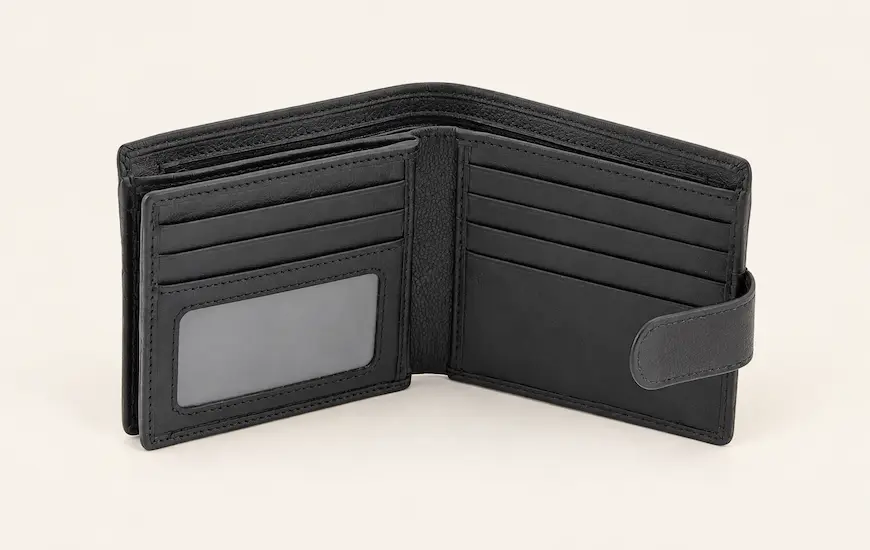
Do not rely on two cards per slot when calculating what to buy unless the product information explicitly says the slot is designed for it. Leather, lining, slot width and card thickness vary. A shared slot can also make the rear card harder to see or retrieve.
For consistent comparison, treat one physical opening as one physical slot. If you later choose to use a hidden compartment for an occasional card, consider that extra storage—not proof that the wallet has another dedicated slot.
After counting cards, run a separate audit for everything else:
This is why two people with the same eight-card count may need different wallets. One may want the simplest folding layout. The other may need a coin pouch, two IDs and separated cash storage.
A slot count answers “How many dedicated places are there?” It does not answer “How quickly can I find the right card?” Look at the open-wallet photos and map the layout to your routine.
Product photos should show the wallet open, not only closed. If you cannot see how the slots are arranged, the headline count is less useful.
Leatherland’s exported review analysis found a repeated tension between capacity and bulk. Buyers praised compact wallets when they carried a smaller set, while other buyers specifically sought more dedicated card storage or separate coin and ID sections. The useful lesson is not a universal number. It is to match the wallet to the real job.
“A nice size, not too bulky, with coin section and lots of card slots.”
This is one customer’s experience, not a promise that the same wallet will feel small to everyone. The listed closed dimensions and your own contents remain the better comparison tools.
To make comparisons more consistent, Leatherland uses this method:
This method is intentionally conservative. It gives readers a comparable layout fact without pretending that every card has identical thickness or that every person loads a wallet in the same way.
If you are still deciding on the overall format, use the broader guide to choosing a men’s leather wallet or browse all men’s leather wallets. If your audit confirms that you need many dedicated slots, compare Leatherland’s large-capacity leather wallets. For a smaller physical card set, compare the slim-wallet range.
Count the physical cards you genuinely need to carry and choose at least that many verified dedicated slots if you want every card separately accessible. Then assess ID, cash, coins and receipts as separate storage needs. There is no universal ideal number.
It can be enough if your audit leaves four or fewer physical cards and the wallet provides the note or extra storage you need. A four-slot wallet is not enough when you must double up cards or misuse other compartments to carry your regular set.
For a clear comparison, record the ID window separately. It may hold a card-shaped ID, but it has a different purpose and access design from a standard card slot.
Do not assume they can when choosing capacity. Slot construction and card thickness vary, and shared storage can reduce visibility and access. Count one physical opening as one slot unless the product information explicitly supports more.
Look for the number explicitly tied to physical card slots in the detailed description. Headline capacity may use a different counting method. If the method is unclear, do not treat the larger number as a verified physical slot count.
Not automatically. Coin storage and card capacity are separate requirements. Choose a wallet with enough verified card slots and a purpose-built closed coin section; the highest slot count may not be the most suitable layout.



Add your favourites to cart

Select Afterpay at checkout

Log into or create your Afterpay account, with instant approval decision

Your purchase will be split into 4 payments, payable every 2 weeks
All you need to apply is to have a debit or credit card, to be over 18 years of age, and to be a resident of country offering Afterpay
Late fees and additional eligibility criteria apply. The first payment may be due at the time of purchase
For complete terms visit afterpay.com/terms